

If you’re a tea beginner hunting for a clear Chinese tea classification tutorial, this all-in-one guide breaks down every popular type of Chinese loose leaf tea based on official national standards, processing oxidation, tea tree varieties, growing altitude, harvest seasons and reprocessing craft. Thousands of global tea enthusiasts search for answers like “what are the six major types of Chinese tea”, “is Pu-erh black tea or dark tea”, “what is high mountain Chinese tea”, “organic tea vs wild abandoned tea” every day — this post resolves all common confusion with verified facts from authoritative Chinese tea documents.
Unlike Western tea markets dominated by mass-produced black tea bags, traditional Chinese tea follows a rigorous multi-dimensional sorting system. Per China’s national tea standard GB/T 30766-2014 and global ISO tea specifications, primary raw tea splits into six official basic tea types sorted by enzymatic oxidation degree: Green Tea, White Tea, Yellow Tea, Qing Tea (widely known as Oolong Tea), Black Tea, and Dark Tea. Many casual tea drinkers mention an informal “eight tea types” grouping that separates Pu-erh tea and scented flower tea as standalone categories for daily communication; however, this folk classification is not scientifically recognized. Pu-erh belongs to Dark Tea, while jasmine tea, osmanthus tea and other floral blends fall under reprocessed tea rather than core primary tea varieties.
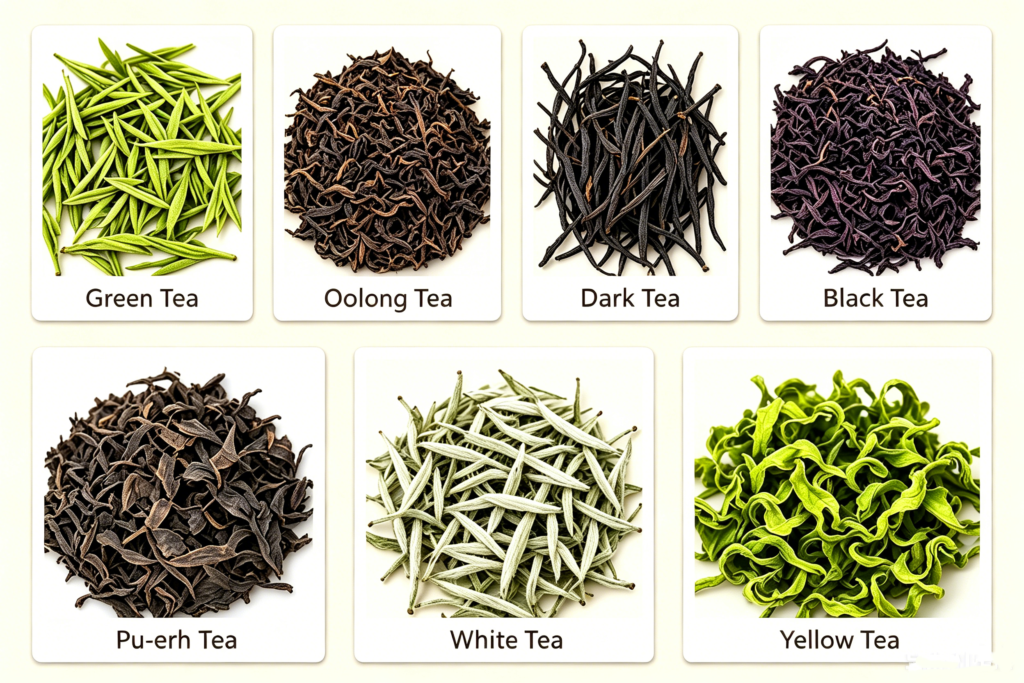
However, according to the latest Chinese standards, Pu-erh tea has been classified as a separate category. For better understanding, the following discussion will focus on seven types of tea: green tea, white tea, yellow tea, oolong tea (also known as light tea), black tea, dark tea, and Pu-erh tea.
Core Classification Rule: Oxidation & Tea Processing Craft
The fundamental dividing line separating all six core Chinese tea types is the degree of enzymatic oxidation — the term “fermentation” used broadly in tea blogging refers to leaf enzyme oxidation, which differs drastically from microbial food fermentation. After fresh tea leaves are plucked, tearing leaf cell walls triggers polyphenol oxidation upon contact with oxygen; tea artisans halt this chemical reaction via high-temperature fixation to create distinct flavor profiles for each tea category.
Two critical fermentation definitions every tea lover should understand:
Enzymatic oxidation: The primary transformation for green, white, yellow, oolong and black tea, relying entirely on natural enzymes inside fresh tea leaves.
Post-microbial damp pile fermentation: Unique to Dark Tea (including ripe Pu-erh tea), combining heat, humidity and beneficial microorganisms to reshape the tea’s taste and texture after primary processing finishes.
Official Chinese Tea Oxidation Level Reference Table
| Tea Category | Oxidation Grade | Oxidation Percentage Range | Signature Processing Technique |
| Green Tea | Almost non-oxidized | Below 5% | High-temperature pan-firing / steaming to lock fresh leaf enzymes instantly |
| White Tea | Minimally oxidized | 5%–10% | Natural outdoor withering + sun-drying, no stir-frying or rolling steps |
| Yellow Tea | Lightly oxidized | 10%–20% | Unique sealed “yellowing” resting stage after fixation |
| Oolong (Qing Tea) | Semi-oxidized | 15%–50% | Controlled leaf bruising to form the classic “green leaf with red edges” trait |
| Black Tea | Fully oxidized | 70%–80% | Complete full enzymatic oxidation before final drying |
| Dark Tea | Post-microbial fermented | 90%–100% | Artificial damp pile microbial fermentation after raw tea shaping |
*Fermentation here actually refers to enzymatic oxidation reaction
Full Breakdown of the Six Official Basic Chinese Tea Types
1. Green Tea (Non-Oxidized Fresh Tea)
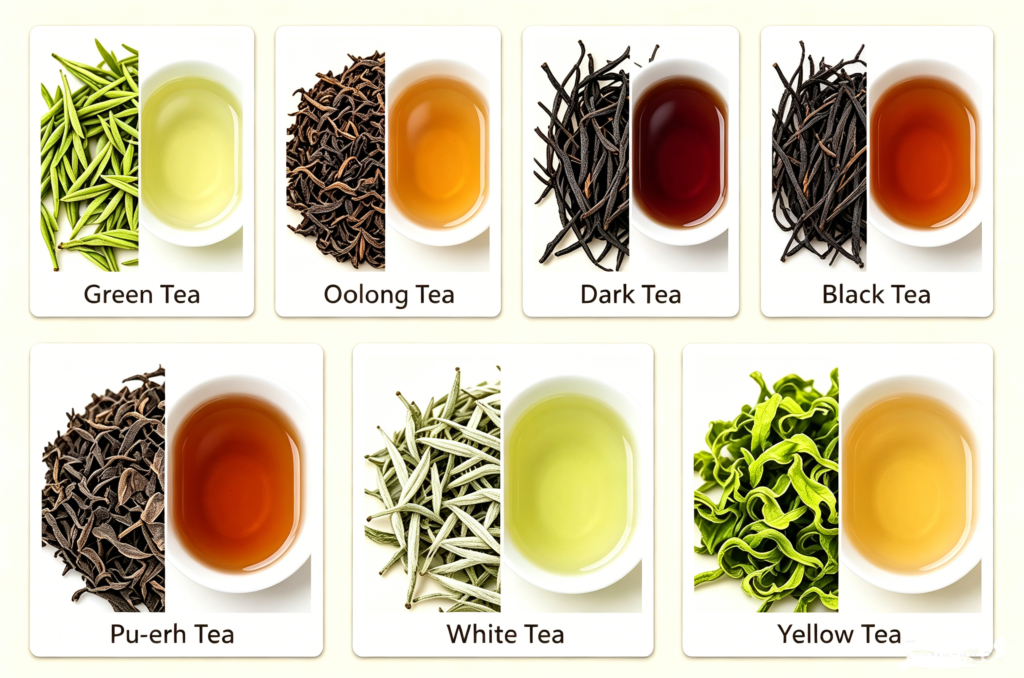
Green tea stands as the most widely consumed unoxidized Chinese tea worldwide. Right after harvesting, fresh tender leaves are heated to 100–200°C to deactivate oxidase enzymes, fully preserving the natural green plant pigments inside leaves. Its iconic identifying feature is “green dry leaves, clear green liquor, soft green leaf base”.
Four mainstream green tea production methods exist: pan-fried, baked, steamed and sun-dried green tea. The flavor delivers bright vegetal freshness, subtle floral sweetness and crisp clean finish, packed with high levels of catechins and natural antioxidants. Tea experts recommend drinking green tea in spring and summer for gentle detoxification and sustained daily focus without harsh caffeine crashes.
Famous premium green tea varieties beginners must try: West Lake Longjing Dragon Well Tea, Dongting Biluochun Spring Spiral Tea, Huangshan Maofeng, Mengding Ganlu, Anji White Tea, Taiping Houkui.
2. White Tea (Minimally Processed Natural Tea)
Known as the gentlest, least processed tea in the Chinese tea spectrum, white tea requires almost zero manual manipulation during production — only natural withering and slow sun-drying, with no fixation or heavy rolling steps. Top-grade white tea buds and tender young leaves are fully covered in silvery white fine hairs, a characteristic tea farmers call “three whites”.
White tea carries the lowest caffeine concentration among all six core tea types, offering mild floral sweetness and an ultra-silky smooth mouthfeel that suits sensitive stomachs perfectly. It works wonderfully for late-night drinking, skin health support and boosting daily immune function.
Top popular white tea cultivars: Bai Hao Yinzhen Silver Needle, Bai Mu Dan White Peony, Gong Mei, Shou Mei Longevity Eyebrow Tea.
3. Yellow Tea (Rare Lightly Oxidized Collector’s Tea)
Yellow tea shares identical early processing steps with green tea, with one exclusive extra stage: sealed low-temperature yellowing resting. This unique craft creates its signature “yellow dry leaves, golden yellow liquor, soft yellow leaf base” appearance, eliminating the sharp grassy bitterness found in standard green tea. The resulting flavor is soft, mellow and naturally sweet, with a milder cooling property that digests easier for people with delicate digestive systems.
Complex multi-step production and limited annual yields make yellow tea extremely scarce in overseas tea markets, valued as a premium collectible tea for serious connoisseurs.
Well-known yellow tea varieties: Junshan Yinzhen, Mengding Huang Ya, Huo Shan Huang Da Ya, Pingyang Huang Tang.
4. Oolong Tea (Qing Tea, Semi-Oxidized Kung Fu Tea)
Officially named Qing Tea, oolong sits perfectly between green tea and black tea on the oxidation spectrum. It features the most intricate, time-consuming production workflow and strict traditional brewing rituals, earning it the nickname “Kung Fu Tea” among Chinese tea drinkers. Traditional oolong displays distinct “green leaf with red edges” from controlled oxidation on leaf margins; modern light-aroma oolong styles reduce oxidation intensity to weaken this visual feature for softer floral flavors.
Oolong delivers the most layered flavor range of all Chinese teas, showcasing bright floral notes, ripe fruit sweetness, honey aroma and rich roasted mineral undertones with a long lingering aftertaste. It remains a top choice for fat digestion support, stress relief and leisurely afternoon tea sessions.
Iconic oolong tea styles: Tieguanyin Iron Goddess of Mercy, Da Hong Pao Big Red Robe Wuyi Rock Tea, Dongding Taiwan High Mountain Oolong, Phoenix Dancong Single Bush, Oriental Beauty Heavy Oxidation Oolong.
5. Black Tea (Fully Oxidized Warm Season Tea)
Originating in Fujian Province in the early 16th century, Chinese black tea undergoes complete full enzymatic oxidation, distinguished by its signature traits: “red dry leaves dotted with golden tips, deep red thick liquor, soft uniform red leaf base”. It contains no grassy astringency, replaced by warm malty, ripe fruit and honey sweetness. Black tea holds a warming herbal property, ideal for autumn and winter consumption to boost blood circulation and ease heavy digestion after rich meals.
World-famous Chinese black tea varieties: Keemun Black Tea, Lapsang Souchong Pine Smoky Black Tea, Yunnan Dianhong, Ninghong Jiangxi Black Tea.
6. Dark Tea (Post-Fermented Aged Tea, Includes Pu-erh Tea)
Dark tea is defined by post-production damp pile fermentation combining steady heat, humidity and natural microbial activity, with oxidation levels hitting 90%–100%. Dry dark tea leaves appear deep dark brown, brewed liquor turns rich crimson and transparent, and the leaf base maintains elastic brown texture with natural aged fermented fragrance. Long-term microbial transformation generates beneficial probiotic flora inside the tea, delivering proven gastrointestinal support benefits for regular drinkers.
Critical Pu-erh Tea Classification Correction
Per official Chinese national tea standards, Pu-erh tea is a subcategory of Dark Tea, exclusively manufactured from sun-dried raw large-leaf tea grown within Yunnan’s protected geographic tea zones. Pu-erh splits clearly into two distinct styles:
Raw Pu-erh (Sheng Pu): No artificial post-fermentation applied during processing; light herbal, fresh crisp taste similar to unoxidized green tea, excellent for boosting metabolism. Proper long-term natural storage triggers slow secondary microbial aging over years.
Ripe Pu-erh (Shou Pu): Undergoes controlled artificial damp pile fermentation, producing mellow earthy, ultra-smooth flavor that is extremely gentle on sensitive stomachs.
Pu-erh is the only Chinese tea crafted specifically for long-term aging; well-stored aged Pu-erh grows softer, sweeter and gains higher collectible value as time passes.
Famous Dark Tea varieties beyond Pu-erh: Fu Brick Tea, Liupao Six Treasure Tea, Sichuan Zang Tibetan Tea; raw and ripe Pu-erh cakes, bricks and tuo cha stand as Yunnan’s iconic dark tea products.
Reprocessed Tea: Scented Flower Tea (Not a Core Basic Tea Category)
Scented flower tea counts as a classic secondary reprocessed tea, not an independent seventh or eighth primary tea category. Tea artisans use any of the six core basic teas as blank tea bases (most commonly green tea, plus small batches of black tea, oolong and loose raw Pu-erh), repeatedly scenting the tea leaves with fresh edible blossoms to absorb lasting natural floral fragrance.
Flower tea blends combine the nutritional benefits of tea leaves and aromatic healing properties of fresh flowers, making them wildly popular for casual daily drinking among beginner tea lovers. Popular floral tea blends: Jasmine Tea, Osmanthus Longjing, Rose Black Tea, Chrysanthemum Pu-erh.
Other common reprocessed tea formats include compressed tea (cakes, bricks, tuo balls) and tea bags — any core tea category can be pressed into compact shapes or packaged as tea bags, meaning physical form never defines a tea’s official classification group.
Multi-Dimensional Auxiliary Chinese Tea Classification Systems
Beyond the oxidation-based core six-tea sorting system, Chinese tea professionals use four additional practical classification frameworks for industry communication and quality evaluation, all sourced directly from authoritative tea reference materials.
1. Classification by Mature Tea Leaf Size (Leaf Specie Standard)
Tea trees split into four groups based on fully mature leaf length and total leaf surface area, with general matching guidelines for suitable tea production (rules are suggestive, not absolute):
| Leaf Variety | Mature Leaf Length | Total Leaf Area | Most Common Matching Tea Types |
| Small Leaf Tea Plant | Under 7 cm | Less than 20 cm² | Green Tea, White Tea, Yellow Tea, Light-roast Black Tea |
| Medium Leaf Tea Plant | 7–10 cm | 20–40 cm² | Oolong Tea, All Varieties of Black Tea |
| Large Leaf Tea Plant | 10–14 cm | 40–70 cm² | Yunnan Pu-erh, Dark Tea, Full-bodied Black Tea |
| Extra Large Leaf Tea Plant | Over 14 cm | More than 70 cm² | Raw & Ripe Yunnan Pu-erh, Traditional Dark Tea |
Important note: This pairing rule serves only as a general industry reference. Regional specialty teas frequently break this standard — for example, certain Wuyi rock oolongs use large leaf cultivars, while some Yunnan vintage Pu-erh batches are crafted from medium-small tea leaves.
2. Classification by Tea Tree Growth Morphology (Arbor vs Semi-Arbor vs Shrub Tea Trees)
All Chinese tea trees belong to evergreen Camellia sinensis plants, separated into three distinct growth forms. Crucially, tree type does not equal superior tea quality; flavor profile remains the single most important evaluation metric for tea drinkers.
Arbor Type Tea Trees: Feature a tall, clear central trunk, growing several to over ten meters tall. Most wild ancient tea trees in Yunnan’s mountain tea forests fall into this category. Many densely planted Yunnan terrace arbor tea trees are artificially dwarfed for easy harvesting, yet they retain their genetic arbor classification.
Semi-Arbor Type Tea Trees: A middle ground between arbor and shrub growth habits. Famous examples include Fuding Da Bai Cha white tea bushes, Phoenix Dancong oolong plants and Wuyi Mountain rock tea cultivars.
Shrub Type Tea Trees: Short, compact growth with no distinct central trunk, the dominant tea tree variety across all Jiangnan tea regions for large-scale commercial plantation cultivation.
Supplementary Concept: Terrace Tea
Terrace tea describes densely planted managed tea gardens maintained with regular pruning, chemical fertilization and pesticide treatments. Terrace tea buds and leaves grow thinner with delicate narrow strips, yet final tea quality depends entirely on mountain terroir and processing craft — not whether the tea grows on terraced farmland.
3. Classification by Growing Altitude: High Mountain Tea vs Lowland Flat Tea
The ancient Chinese tea proverb “High mountains produce premium fine tea” holds solid scientific backing. Higher mountain elevations deliver cooler average temperatures, persistent cloud and mist coverage, and wide day-night temperature gaps. These growing conditions slow tea leaf growth, reduce bitter catechin compounds, and boost concentrations of sweet amino acids, pectin and aromatic terpenes that create rich layered flavor. Mountain soil formed from weathered rock deposits supplies abundant natural minerals that elevate tea quality.
Altitude standards for “high mountain tea” vary drastically across China’s tea regions, measured relative to local flat lowland terrain:
Fuding White Tea: Plantations above 600 meters qualify as high mountain white tea
Wuyi Rock Tea: Top-grade high mountain rock tea grows between 400–800 meters above sea level
Phoenix Dancong Oolong: Plantations over 600 meters produce fine tea; batches grown above 800 meters count as premium high mountain dancong
Taiwan Oolong & Yunnan Pu-erh: Tea trees planted at elevations above 1000 meters are officially labeled high mountain tea
Key advantages of high mountain tea: Ultra-soft tender buds, thick nutrient-dense leaf bases, abundant fruit pectin, mild balanced astringency and prominent sweet floral lingering aroma. Flat lowland tea is not inherently inferior to mountain tea — every outstanding tea results from balanced interplay of growing terrain, tea cultivar and skilled artisan processing.
4. Classification by Harvest Season: Spring, Summer, Autumn & Winter Snowflake Tea
Tea farmers harvest fresh tea leaves in four distinct seasonal batches, each delivering unique flavor characteristics shaped by annual climate shifts (tea growers distinguish “big years” with ideal weather and rich tea yields from “small years” with poor climate and lower quality crops).
Spring Tea: The most valuable and sought-after tea harvest of the year. Tea trees store massive nutrient reserves through winter dormancy; spring growth generates abundant aromatic compounds, glossy oily dry leaves, ultra-soft leaf bases with faint leaf serrations, and thick mellow fresh brewed liquor.
Summer Tea: Hot summer temperatures accelerate rapid tea leaf growth, accumulating high levels of bitter catechin compounds with weak aromatic profiles, resulting in noticeably astringent brews that generally rank lower in market value.
Autumn Tea: Cooler autumn temperatures slow leaf growth, creating teas packed with bright complex floral aroma, though brewed liquor carries lighter body and thinner texture compared to spring tea — perfect for aroma-focused tea enthusiasts.
Winter Snowflake Tea: The final late-autumn / early winter harvest, only picked if late-season plucking does not damage the following year’s spring bud growth. Snowflake tea produces thin light liquor but extremely intense concentrated fragrance, primarily harvested for Guangdong Phoenix Dancong oolong production.
5. Ecological Tea, Organic Tea & Wild Abandoned Tea Distinction
Ecological Tea: A vague marketing buzzword with no official national certification standards. The term carries no regulated definition and cannot serve as a credible marker for high-quality, pesticide-free tea.
Organic Tea: Strictly standardized certified tea product. Organic tea production bans all synthetic pesticides, chemical fertilizers, plant growth regulators and genetically modified tea cultivars. Packaging and transportation processes avoid cross-contamination, with valid certification issued by authorized official bodies including OTRDC and OFDC. Green food tea only limits final pesticide residue levels without full oversight of the entire tea farming production cycle.
Wild Abandoned Tea vs Pure Wild Tea:
Regular Garden Tea: Artificially planted tea bushes with consistent scheduled fertilizing, pruning and harvesting management
Abandoned Wild Tea: Man-planted tea bushes left unattended for years without fertilizer or trimming. Tea farm soil requires a minimum 10 years of natural recovery to produce authentic high-quality abandoned wild tea with dense inner nutrients and excellent multiple steeping endurance
Pure Wild Tea: Naturally self-grown tea plants with no human planting intervention, rare protected ancient wild tea forest resources
Frequently Asked Questions About Chinese Tea Classification
Q1: What are the six official major basic types of Chinese tea?
A: Green Tea, White Tea, Qing Tea (Oolong Tea), Black Tea, Dark Tea, and Yellow Tea. Pu-erh tea falls under the Dark Tea category, while scented flower tea counts as reprocessed tea and is not an independent basic tea type. The informal folk “eight tea types” grouping that separates Pu-erh and floral tea only serves casual daily communication and does not align with national scientific tea classification standards.
Q2: Is Pu-erh tea the same as regular Chinese black tea?
A: These two belong to completely separate official tea categories. Black tea achieves full enzymatic oxidation during primary leaf processing. Pu-erh tea, a subcategory of Dark Tea, relies on post-production damp pile microbial fermentation. Raw Pu-erh undergoes almost no oxidation, while ripe Pu-erh experiences deep post-fermentation — a unique production process never used to craft traditional black tea.
Q3: Which Chinese tea varieties work best for absolute beginners?
A: White tea and light-roast green tea rank as the most beginner-friendly options. They retain high concentrations of natural antioxidants with low caffeine content, offering gentle mild flavor profiles that do not irritate sensitive stomachs or carry harsh bitter astringency.
Q4: What Chinese teas support fat digestion and healthy weight management?
A: Medium-roast oolong tea and raw Pu-erh tea deliver the best natural lipid breakdown benefits. Their balanced oxidation levels and polyphenol composition accelerate fat metabolism and support daily intestinal detoxification for regular drinkers.
Q5: Can I drink different varieties of Chinese tea throughout each day?
A: Absolutely. Traditional Chinese tea drinking routines pair teas with seasonal and daily timing: fresh green tea for summer mornings, aromatic oolong for afternoon tea breaks, warming black tea or ripe Pu-erh for autumn and winter evenings, and mild white tea for late-night sipping, balancing bodily comfort and diverse flavor experiences.
Final Complete Summary
Mastering Chinese tea’s multi-layered classification system starts with learning the six core oxidation-based basic tea categories, then expands into secondary sorting frameworks organized by leaf size, tea tree morphology, mountain growing altitude, seasonal harvest timing and reprocessing techniques. Every distinct Chinese tea category carries thousands of years of regional mountain terroir heritage, handcrafted artisan production wisdom and natural wellness benefits passed down through generations.
If you want to deepen your tea knowledge further, explore dedicated brewing tutorials and product introductions for Longjing Green Tea, Tieguanyin Oolong, Da Hong Pao Wuyi Rock Tea, Silver Needle White Tea and aged Pu-erh tea to build a diverse personal loose leaf tea collection.