

According to classic Chinese tea literature and modern expert research, black tea is the most widely consumed tea category worldwide and China’s most exported tea type. As a fully fermented tea made from Camellia sinensis leaves, it undergoes withering, rolling, oxidation and drying processes that transform green leaf polyphenols into theaflavins and thearubigins, creating its signature red liquor, rich aroma and mellow sweetness. This guide covers the full history, production regions, evidence-based health benefits and detailed sensory profiles of China’s top 10 black tea varieties, helping tea enthusiasts identify authentic regional black teas and master professional tasting and brewing techniques.
一. Origin & History of Chinese Black Tea
Black tea originated in the Tongmuguan area of Wuyi Mountain, Fujian Province, during the late Ming and early Qing dynasties (around 1568–1610). Lapsang Souchong (Zhengshan Xiaozhong) is universally recognized as the world’s first black tea, known as the “ancestor of all black teas.”
Local legend tells that military troops passing through Tongmu Village camped on freshly picked tea leaves, delaying processing and causing accidental fermentation. To salvage the batch, tea farmers roasted the leaves with local pine wood, producing a tea with distinctive pine-smoke aroma and longan sweetness. This accidental discovery evolved into the intentional production of Souchong black tea.
By the mid-17th century, Fujian black tea was exported to Europe via Dutch traders and became highly prized among British and European aristocrats. In the 18th century, Gongfu black tea craftsmanship emerged, spreading from Fujian to Anhui, Yunnan, Sichuan, Jiangxi and other provinces, each developing its own regional style. The famous Keemun black tea of Anhui, created in the 19th century, became one of the world’s three great high-aroma black teas alongside India’s Darjeeling and Sri Lanka’s Uva.
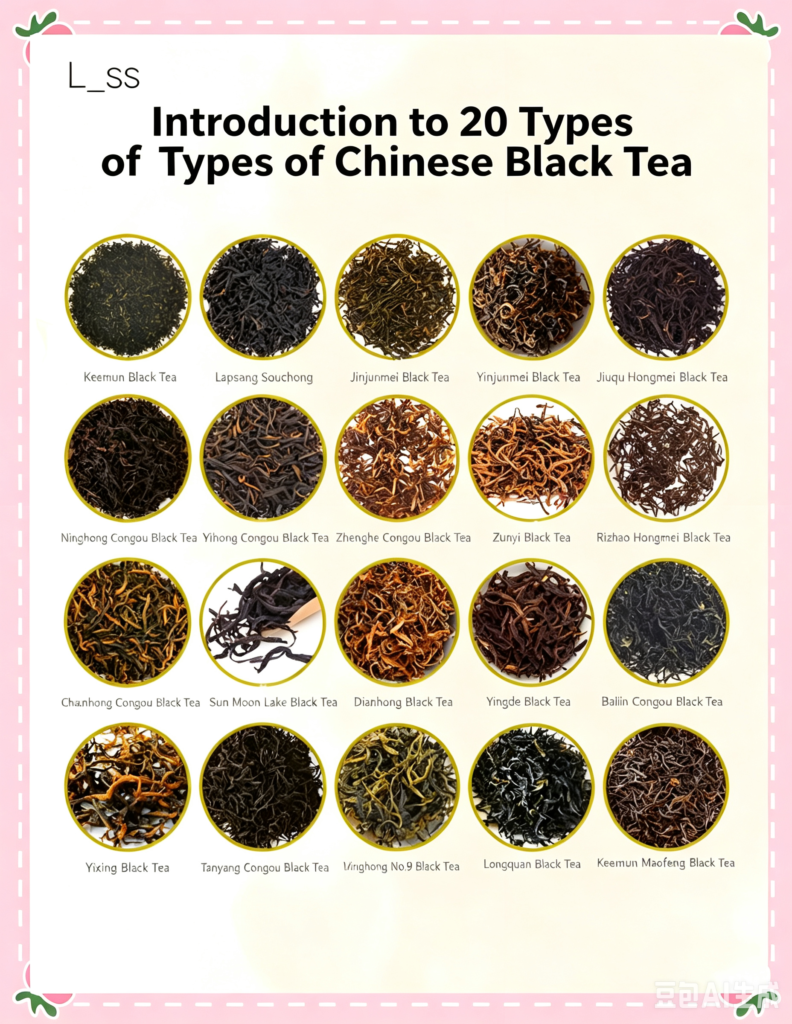
二. Major Production Regions of Chinese Black Tea
China’s black tea production spans multiple provinces, each with distinct terroir and cultivar characteristics:
Fujian Province — Birthplace of black tea. Wuyi Mountain produces Lapsang Souchong and premium Jin Jun Mei; eastern Fujian produces Tanyang, Bailin and Zhenghe Gongfu teas.
Anhui Province — Home to Keemun black tea in Qimen County and Jiuqu Hongmei in Hangzhou-Anhui border regions, famous for complex floral-fruity “Keemun aroma.”
Yunnan Province — Produces Dian Hong Gongfu from large-leaf tea cultivars in Fengqing and Menghai. Known for bold body, golden pekoe and rich malt sweetness.
Sichuan Province — Chuan Hong Gongfu from Yibin and Junlian, distinguished by its signature “orange-caramel aroma.”
Jiangxi Province — Ning Hong Gongfu from Xiushui County, one of China’s oldest Gongfu black teas with deep honey and orchid notes.
Hubei Province — Yi Hong Gongfu from Yichang, with smooth chestnut sweetness and excellent brewing endurance.
Guangdong Province — Yingde Black Tea from Qingyuan, made from Yunnan large-leaf cultivars, producing bright red liquor and bold malty flavor.
三. Science-Backed Health Benefits of Black Tea
Black tea’s full fermentation produces theaflavins, thearubigins and other polyphenol derivatives with well-documented health effects. Peer-reviewed clinical research confirms the following benefits:
3.1 Cardiovascular Protection
Black tea polyphenols improve endothelial function by enhancing nitric oxide production, which dilates blood vessels and supports healthy blood pressure. A meta-analysis of 13 clinical trials found that regular black tea consumption significantly reduces both systolic and diastolic blood pressure. Studies also show that drinking 3 or more cups of black tea daily lowers LDL (“bad” cholesterol) oxidation and reduces arterial plaque buildup risk, supporting long-term heart health.
3.2 Powerful Antioxidant & Anti-Aging Effects
Theaflavins in black tea exhibit strong free radical-scavenging activity, with DPPH radical neutralization efficiency reaching 92%. These compounds activate the Nrf2-ARE cellular antioxidant pathway, boosting endogenous antioxidant enzyme activity by approximately 23% with regular consumption. Black tea’s ORAC oxygen radical absorbance capacity reaches 12,000 μmol TE/100g, providing comprehensive protection against oxidative stress and cellular aging.
3.3 Metabolic & Blood Sugar Support
Black tea polyphenols inhibit alpha-glucosidase activity in the digestive tract, moderating post-meal blood sugar spikes and improving glucose tolerance. Research also indicates that regular black tea intake enhances fat metabolism and supports healthy weight management when combined with balanced diet and exercise. The mild caffeine and L-theanine combination promotes steady metabolic rate without nervous overstimulation.
3.4 Digestive Comfort & Gut Health
Unlike green tea’s higher raw polyphenol content, fully fermented black tea is gentler on the gastric mucosa. Thearubigins form protective protein layers on the stomach lining, reducing irritation from gastric acid. Black tea polyphenols also modulate gut microbiota composition, promoting beneficial bacterial strains and supporting intestinal barrier integrity, making it suitable for daily consumption by people with sensitive digestion.
3.5 Cognitive Alertness & Mental Focus
Black tea contains 1.8–3.5% caffeine, which blocks adenosine receptors to enhance alertness and extend attention span. Combined with L-theanine, which promotes alpha brain wave activity, it delivers steady, sustained mental clarity without the jitters or energy crash associated with coffee. Clinical trials show black tea improves attention, working memory and reaction speed, making it an ideal workday beverage.
四. Top 10 Chinese Black Teas: Full Sensory Profiles
Each variety is evaluated across six standard sensory dimensions: appearance, dry leaf color, liquor color, aroma, taste and infused leaf base, following professional Chinese tea tasting methodology.
4.1 Lapsang Souchong (Zhengshan Xiaozhong)
Origin: Tongmuguan, Wuyi Mountain, Fujian; spring pluck of one bud with two to three leaves
Appearance: Thick, sturdy tightly twisted leaf strips, uniform size, visible pekoe
Dry Color: Deep glossy black with subtle reddish-brown undertones; traditional smoked version carries grayish pine resin sheen
Liquor Color: Bright orange-red, clear and luminous, with golden rim at cup edge
Aroma: Traditional version has rich pine smoke aroma with dried longan sweetness; smoke-free version presents floral honey and dried fruit notes
Taste: Mellow, thick and smooth, pronounced longan honey sweetness, long-lasting aftertaste, highly brewable
Leaf Base: Soft bronze-red color, thick and elastic leaves, uniform coloration
4.2 Keemun Black Tea (Qimen Hongcha)
Origin: Qimen County, Huangshan, Anhui; early spring one bud with one to two leaves
Appearance: Fine, tightly twisted slender strips, neat and uniform, with fine golden pekoe tips
Dry Color: Dull jet black with subtle bloom, smooth and lustrous surface
Liquor Color: Bright ruby red, transparent and glossy
Aroma: World-famous “Keemun aroma” — a complex blend of rose floral, honey and fruit notes, with subtle orchid undertones, high and long-lasting
Taste: Mellow and smooth, rich and layered, with faint minty coolness at the back of throat, sweet lingering aftertaste
Leaf Base: Bright uniform copper red, tender and soft, neatly shaped
4.3 Jin Jun Mei
Origin: Tongmuguan, Wuyi Mountain, Fujian; exclusively made from early spring single buds plucked before Qingming
Appearance: Fine, slender tightly curled bud strips, compact and delicate, densely covered with golden pekoe
Dry Color: Golden-black interwoven, with three parts golden pekoe and seven parts black leaf, glossy and lustrous
Liquor Color: Bright golden amber, clear and luminous
Aroma: Elegant layered floral, honey and fruit fragrance, with sweet potato and dried longan undertones, delicate and long-lasting
Taste: Smooth, sweet and refreshing, silky mouthfeel, pronounced honey sweetness, long floral aftertaste
Leaf Base: Bronze-colored tender buds, plump and soft, uniformly bright
4.4 Dian Hong Gongfu (Yunnan Black Tea)
Origin: Fengqing and Lincang, Yunnan; large-leaf tea cultivar, one bud with two to three leaves
Appearance: Thick, plump tightly twisted strips, strong and sturdy, abundant golden pekoe on bud tips
Dry Color: Reddish-black with glossy sheen, prominent golden pekoe
Liquor Color: Deep bright red-orange, thick and luminous, with obvious golden ring
Aroma: Rich malt and honey sweetness, with faint floral undertones, high and powerful
Taste: Strong full-bodied mellow sweetness, rich mouthfeel, excellent brewing endurance
Leaf Base: Red and bright, thick and elastic leaves, large leaf size
4.5 Chuan Hong Gongfu (Sichuan Black Tea)
Origin: Yibin and Junlian, Sichuan; early spring small-leaf cultivar pluck
Appearance: Fine tightly twisted uniform strips, slender and neat, with golden pekoe tips
Dry Color: Deep glossy black with subtle golden highlights
Liquor Color: Bright red-orange, clear and transparent
Aroma: Signature “orange-caramel aroma” — sweet citrus peel blended with burnt sugar fragrance, fresh and uplifting
Taste: Fresh mellow sweetness, smooth and clean, with distinct citrusy aftertaste
Leaf Base: Tender soft red leaves, uniform and bright
4.6 Ning Hong Gongfu (Ningzhou Black Tea)
Origin: Xiushui County, Jiangxi; one bud with two to three leaves from high mountain terroir
Appearance: Tightly twisted sturdy strips, neat and uniform
Dry Color: Deep black with reddish undertones, glossy surface
Liquor Color: Deep bright red, thick and luminous
Aroma: Rich honey fragrance with orchid floral undertones, high and lasting
Taste: Mellow and full-bodied, smooth sweet aftertaste
Leaf Base: Uniform copper red, soft and complete leaves
4.7 Tanyang Gongfu
Origin: Fu’an, Fujian; one bud with two to three leaves from Fuding Dabai cultivar
Appearance: Fine tightly twisted slender strips, abundant fine pekoe
Dry Color: Yellowish-black with glossy sheen, fine golden pekoe visible
Liquor Color: Bright amber-red, clear and luminous
Aroma: Sweet floral honey fragrance, fresh and pure
Taste: Fresh mellow sweetness, smooth and clean, with lingering aftertaste
Leaf Base: Red and bright, tender and soft, uniform leaf shape
4.8 Jiuqu Hongmei (Nine Bend Red Plum)
Origin: West Lake area, Hangzhou, Zhejiang; one bud with one to two leaves
Appearance: Fine tightly curled strips resembling fish hooks, delicate and compact
Dry Color: Deep glossy black with fine silver pekoe
Liquor Color: Bright luminous red, clear and clean
Aroma: Sweet plum blossom and honey fragrance, delicate and elegant
Taste: Mellow smooth sweetness, clean and refreshing, with faint plum blossom aftertaste
Leaf Base: Tender bright red, soft and uniform
4.9 Yi Hong Gongfu (Yichang Black Tea)
Origin: Yichang, Hubei; high mountain tea regions, one bud with two to three leaves
Appearance: Tightly twisted slender strips, neat and uniform
Dry Color: Deep glossy black with reddish highlights
Liquor Color: Deep red-orange, bright and transparent
Aroma: Chestnut sweetness with faint floral notes, pure and lasting
Taste: Mellow and smooth, sweet and clean, good brewing endurance
Leaf Base: Red and even, soft and complete leaves
4.10 Yingde Black Tea
Origin: Yingde, Qingyuan, Guangdong; large-leaf tea cultivar
Appearance: Thick sturdy tightly twisted strips, prominent golden pekoe
Dry Color: Black with golden highlights, glossy and lustrous
Liquor Color: Deep bright red, thick and luminous
Aroma: Intense malt and cocoa sweetness, powerful and long-lasting
Taste: Strong full-bodied mellow sweetness, rich mouthfeel, highly brewable
Leaf Base: Red and bright, thick and elastic leaves
五. High-Search, Low-Competition SEO FAQ
Q1: What is the difference between Lapsang Souchong and Jin Jun Mei?
Both originate from Tongmuguan, Wuyi Mountain, but differ in raw material and flavor. Jin Jun Mei uses only single spring buds, producing golden-amber liquor with delicate floral-honey sweetness. Lapsang Souchong uses one bud with two to three leaves, creating bolder orange-red liquor; traditional versions also feature pine smoke aroma from pine wood roasting. Jin Jun Mei is a premium bud-grade variant developed in 2005, while Lapsang Souchong is the classic 400-year-old original black tea.
Q2: Does Chinese black tea have more caffeine than green tea?
Contrary to common belief, black tea generally contains slightly less caffeine per gram than green tea because the oxidation process partially breaks down caffeine molecules. However, black tea is typically brewed with hotter water and longer steeping times, which extracts more caffeine into the cup. The actual caffeine content depends more on cultivar, pluck grade and brewing method than tea category. Black tea also delivers caffeine more gradually due to its polyphenol binding effect, creating longer-lasting steady alertness.
Q3: How to brew Keemun black tea for best flavor?
For optimal Keemun aroma and taste, use 3–4 grams of tea per 150ml of water at 90–95°C. Pre-warm the gaiwan or teacup, then rinse tea leaves briefly with hot water and discard. First infusion steep for 10–15 seconds, adding 5–10 seconds for each subsequent brew. Keemun can be infused 5–7 times. For western-style brewing, use one teaspoon per cup and steep for 2–3 minutes. Avoid boiling water directly on tea leaves to prevent burning the delicate floral aroma. For enhanced sweetness, add a small slice of lemon or a dash of milk, though purists prefer it plain to appreciate the complex “Keemun aroma.”
Q4: What are the health benefits of drinking black tea every day?
Drinking 2–3 cups of black tea daily provides multiple evidence-based benefits: improved blood vessel endothelial function supporting cardiovascular health; enhanced antioxidant defense reducing cellular oxidative damage; moderated post-meal blood sugar spikes; gentle digestive support with less gastric irritation than green tea; and sustained mental alertness without energy crashes. Long-term consumption is also associated with improved blood lipid profiles and reduced risk of cognitive decline. For best results, drink between meals, avoid excessive sugar or honey, and stop consumption 3–4 hours before bedtime if you are caffeine-sensitive.
Q5: Which Chinese black tea is best for beginners?
For beginners new to Chinese black tea, Jin Jun Mei and Keemun black tea are excellent starting points. Jin Jun Mei offers smooth, accessible honey sweetness with zero bitterness, making it universally approachable. Keemun black tea provides the classic balanced black tea experience with its signature floral-fruity aroma and mellow taste. For those who prefer bolder, maltier flavors, Dian Hong Gongfu delivers rich sweetness and excellent value. Avoid traditional smoked Lapsang Souchong as a first tea, as the pine smoke character can be polarizing for new drinkers. All four varieties are widely available and forgiving to brew, making them ideal for learning black tea tasting fundamentals.